
Blog
Generic AI: The Hidden Risk of Using ChatGPT for Workplace Disputes
Without an early, clear picture of where they stand legally, people facing employment disputes get trapped in drawn-out battles that drain huge amounts of time, money and emotional energy. Generic AI tools have compounded the problem, by drawing on open source web content and providing an unrealistic view of the strength of a person’s case. Reso solves this by instantly analysing evidence against verified NZ legislation and case law to deliver objective legal clarity in under five minutes - helping employees, employers, HR teams and regulators resolve issues faster and avoid unnecessary stress and expense.
Reso team
Before we launched Reso, we asked employees, business owners, HR teams and regulators what’s really broken about employment disputes. We got four versions of the same answer: it takes too long to find out whether a claim has legitimate legal grounds.
For some people it’s a knowledge problem. They’re guessing, or spending money on legal advice just to find out where they stand. For others it’s a volume problem. They have a queue of claims that all sound convincing, and it takes hours to separate genuine breaches from baseless demands.
Either way, without an early view of the legal position, everyone loses time, money and sleep. Minor grievances escalate into full-blown conflicts because neither party has an objective benchmark early on to reality-test their position.
Generic AI has made this worse: false hope, rather than legal grounding
Employees are using AI platforms to test a genuine concern. They get an empathetic response that convinces them they have a strong case, and they start a dispute process they might have avoided if they’d known about the delays, paperwork and stress involved.
Employers are receiving formal-sounding letters citing legislation and case names. Understandably worried, they call their lawyers or spend a lot of time doing their own research.
Regulators and courts are carrying the load. Applications to the Employment Relations Authority rose 45% in two years, and AI-generated filings citing cases that don’t exist are adding to the pressure.
The issue comes down to how generic AI works. It’s designed to be agreeable rather than accurate, it draws on global web content rather than New Zealand law, and when it doesn’t know something it can fill the gap with information that isn’t true. The result is two parties with very different ideas of what a fair outcome looks like.
How Reso is different
We built Reso to give people legal clarity early. It was co-founded by commercial litigator James Wollerman to address the delays and costs that come with traditional disputes. Reso uses AI for what it does well, which is analysing evidence quickly, and grounds that analysis in verified New Zealand legislation and case law.
There are three ways to use it.
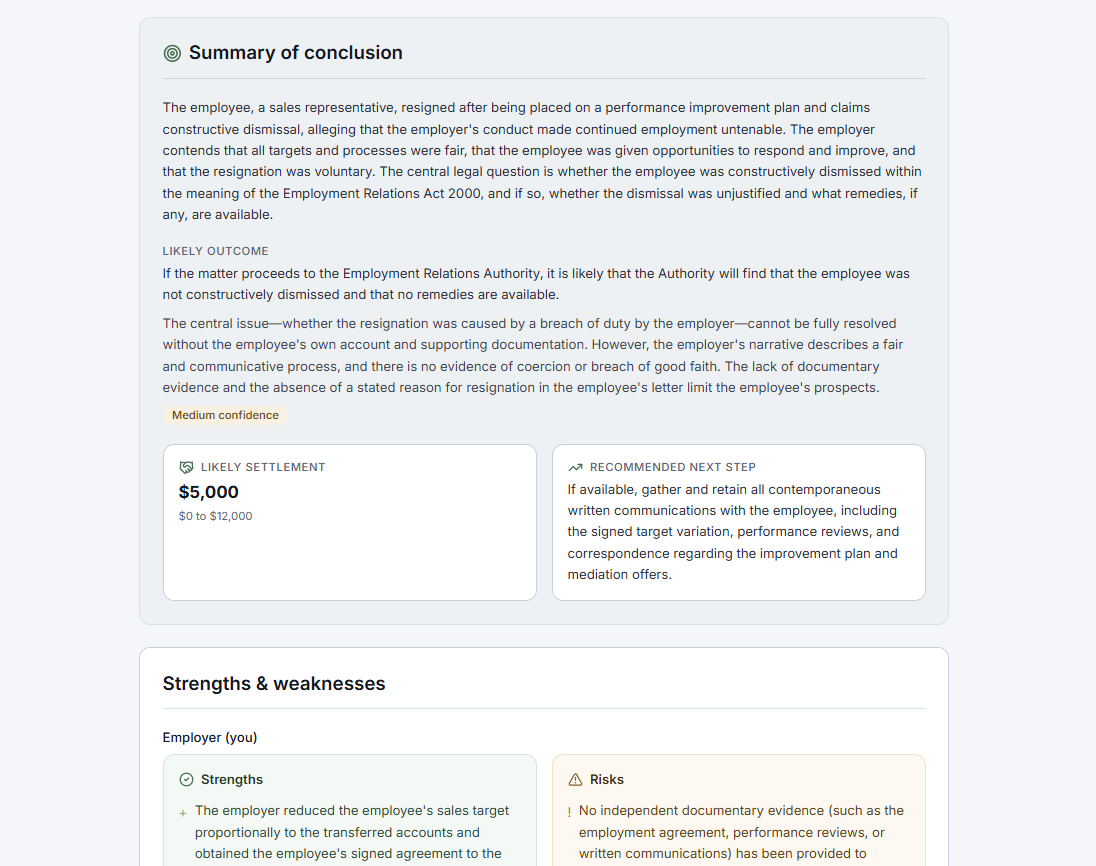
For one party: submit what happened along with your evidence, such as emails, contracts or file notes. In under five minutes, Reso gives you an objective view of your legal position, the risks and practical next steps. You don’t need to be in a formal dispute to use it. Wanting clarity on a situation is reason enough.
For both parties: use Reso as a first step toward resolving a dispute. Each party submits their account and evidence separately. Reso assesses both against the same law and produces one shared report, including settlement benchmarks based on how similar cases have been decided.
At volume: HR teams, mediators and regulators can use Reso to triage claims quickly, identifying which ones have merit so their people can focus on the cases that need them.
What would normally take weeks and cost money in advice can be done in a few minutes.
Resolution over escalation
Reso gives everyone an unbiased view of the legal position from the start. When people understand where they stand early on, they begin negotiations closer together, disputes settle sooner, and the formal process is left for the complex cases that genuinely need it.
Employment disputes are personal, and knowing your legal position doesn’t change that. But it does let people focus on resolving the issue rather than prolonging it.
#EmploymentLaw #HR #NewZealand